Parco Schuster: nature supporting accessibility and social inclusion
The iconic park in the Ostiense district is the site of green Redevelopment initiatives in the areas adjacent to the Vatican and the Jubilee Basilicas, promoted by Società Giubileo 2025 S.p.A. as the implementing entity in preparation for the Holy Year. Through its regeneration, LAND aims to establish a new identity focused on social engagement and sharing, featuring educational and interactive activities, as well as multisensory pathways immersed in nature.
A frame of Nature in the heart of Rome. A flexible and multifunctional public space dedicated to social inclusion, designed to meet the diverse needs of the community with a focus on sharing and accessibility. This is the vision behind the Parco Schuster project, developed by LAND in collaboration with a-fact architecture factory (formerly Parallel Collective), Proger, and GAe Engineering Srl, commissioned by Società Giubileo 2025 S.p.A., the implementing entity of the intervention, in preparation for the Holy Year.
The historic green area, named Parco Paolini in 1942 and later renamed Parco Schuster in honor of Cardinal Schuster, is a large triangular space facing the Basilica of San Paolo fuori le Mura, one of the four Jubilee Basilicas in Rome. LAND’s intervention builds upon and further develops the redesign initiated for the Jubilee of 2000, aimed at promoting pedestrianization, expanding green spaces, reorganizing access for pilgrims and tourists, and restoring the relationship between the basilica and its surrounding environment.
LAND’s landscape design draws inspiration from the historical legacy and layers of the park, with the goal of returning a public space to the community for daily use by residents and visitors alike. It envisions an open area shielded from traffic, suitable for rest and contemplation, aligning with the needs of both religious and urban tourism. The park integrates diverse landscapes into a harmonious whole, creating a natural perimeter within which various user groups can engage in social dynamics, educational activities, and interactive experiences, including multisensory and cultural pathways.
“The regeneration of Parco Schuster follows the guidelines of the Arcipelago Verde strategy, fitting into the process of integrating Rome’s central areas with existing parks and natural reserves. This approach aims to rediscover and enhance the biodiversity and rich landscape heritage of the capital,” says Andreas Kipar, CEO of LAND and project leader. “By reconnecting people with nature, we can create new gathering spaces that form part of a network of ‘slow’ connections, linking the city center with its peripheries and fostering Rome’s transformation into an urban landscape.”
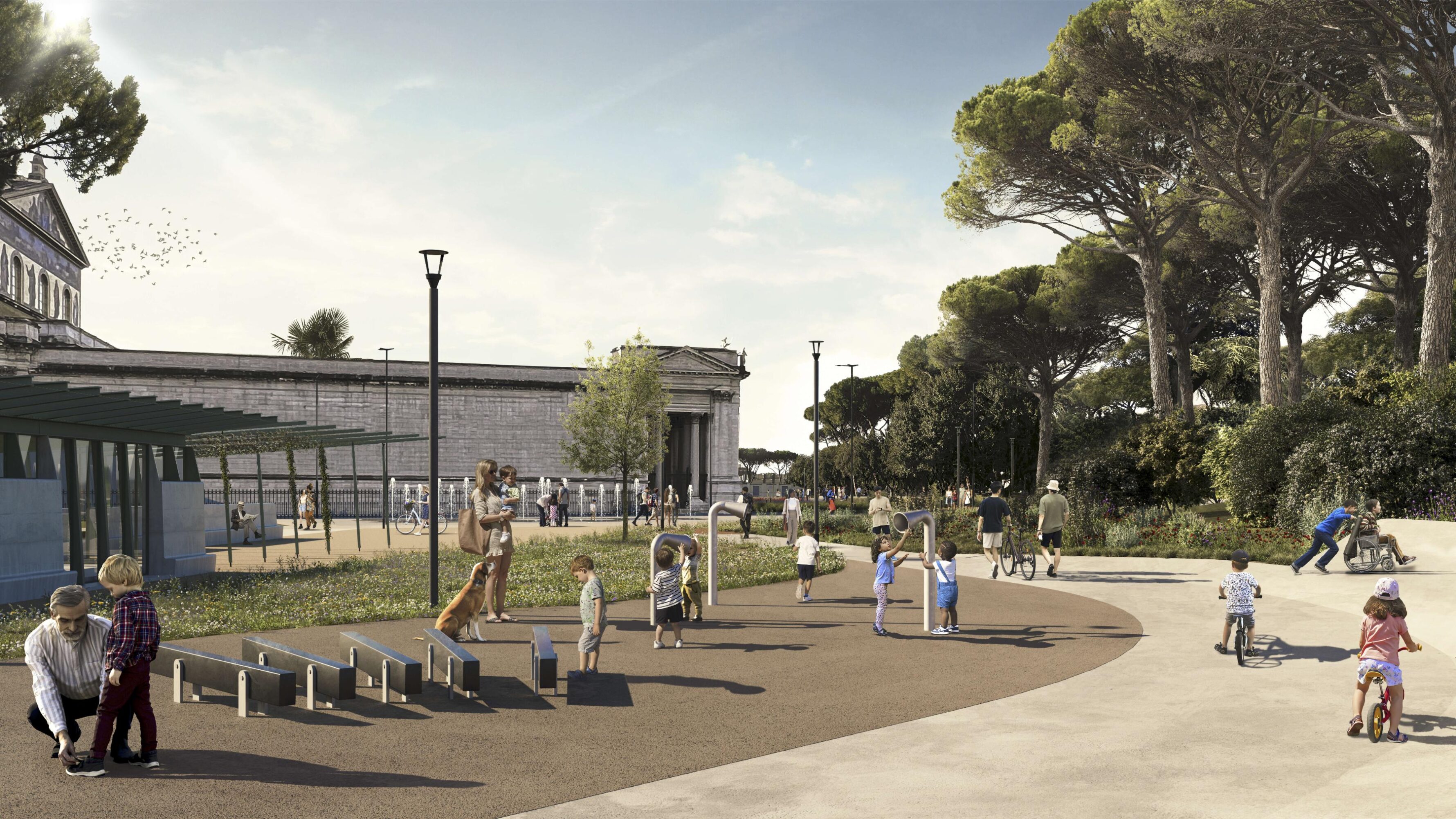
Playground in Parco Schuster. Image by Alessandro Argentesi
“The growing centrality of public spaces in our cities drives their constant evolution into hubs of services for citizens and visitors,” says Giovanni Sanna, founding partner of a-fact architecture factory. “Revitalizing existing architectural heritage, such as the structures designed by architect Cellini within Parco Schuster, is crucial to preserving green and permeable areas without compromising their balance.”
The use of nature-based solutions, such as permeable materials, enhances the microclimate, promotes climate resilience, and lends the park a distinctive identity. Inclusive design and welcoming spaces ensure easy access to nature, offering people the opportunity to protect and care for the environment directly. In line with the park’s historical vocation, LAND’s intervention includes restoring and cleaning existing pavements made of Roman white travertine and terrazzo, ensuring maximum accessibility for pilgrims and residents with inclusive furniture and playgrounds.
The project remains open to adjustments aimed at better addressing the needs of the area and the community in preparation for the Jubilee.
Date
13 December 2024
People
Maria Luisa CarloniMariangela CeroneGianluca DanziAndreas KiparAndrea Bulloni
Office