Newsletter #25: Crossing Bridges: Cultivating Positive Impact With Nature
As the year draws to a close, I find myself looking back with gratitude, and forward with curiosity. This December feels like reaching the far end of a long bridge: a year of crossings between continents, disciplines, and generations. And perhaps more than ever, I sense that the challenges we face – environmental, social, and economic – can no longer be addressed in isolation. They demand alignment, collaboration, and courage.
Our 2025 concludes with a renewed commitment to our mission of #ReconnectingPeopleWithNature. It has been an active year, marked by extensive behind-the-scenes work that, for the first time, has allowed us to deliver a counter-trend message. While the world seems to be stepping back from ESG criteria, our efforts have brought us, our partners, and collaborators closer to new horizons.
Reaching Milestones, Launching New Beginnings
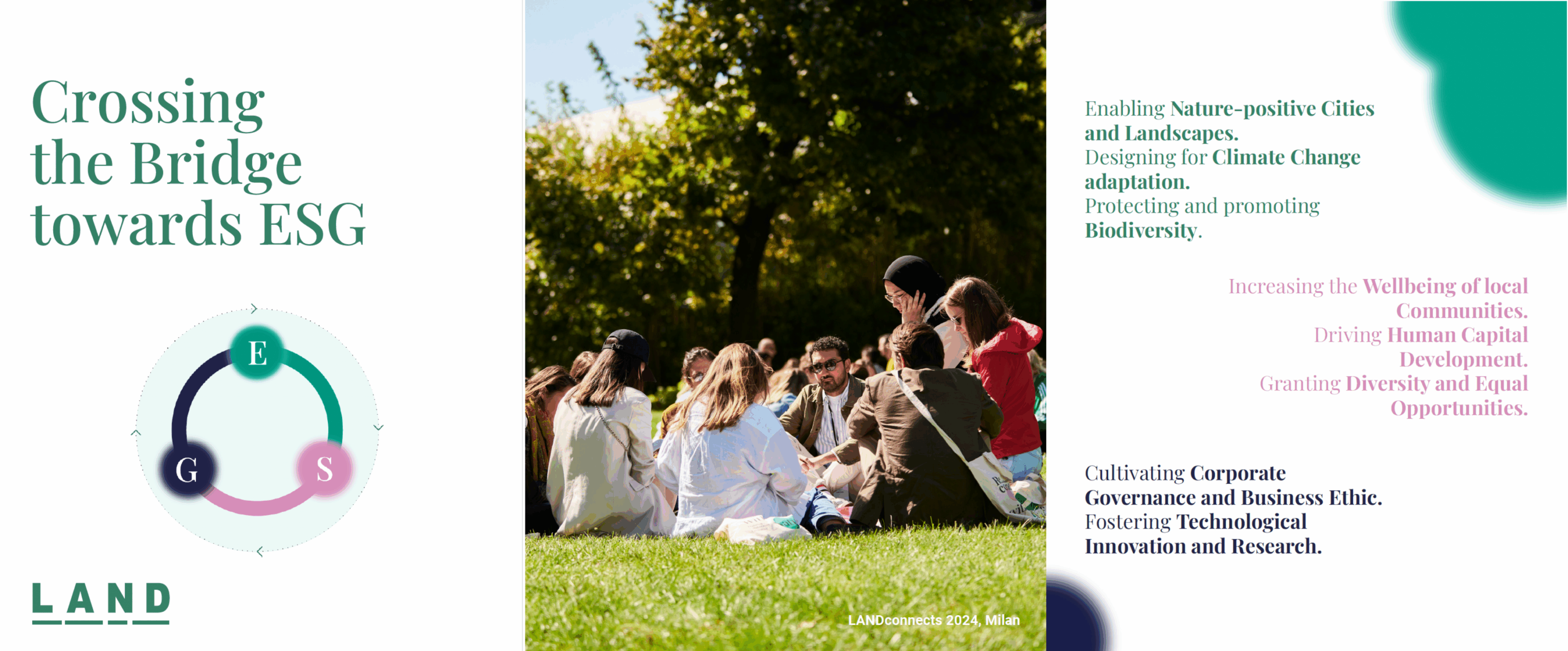
Last November, LAND Italia has published its first ESG Impact Report – “Crossing the Bridge towards ESG”. For us, this is not a box-ticking exercise; it is a milestone in a journey we began long ago.
For 35 years, we have been shaping cities and territories with one guiding mission: Reconnecting People with Nature. With this report, available for consultation upon request via LAND website, we take that mission one step further:
- aligning our Environmental, Social and Governance performance with recognised standards,
- turning values into measurable actions,
- and actions into transparent, verifiable impact.
Like landscape, sustainability must evolve — it cannot rely solely on regulation. It needs shared awareness, responsible innovation, and the conviction that every decision – from a tree we plant to a strategy we design – has consequences for our collective future.
Drawing on internationally recognized frameworks such as the European Sustainability Reporting Standards (ESRS), the Global Reporting Initiative (GRI), and the Voluntary SME Standard (VSME), our approach to ESG follows a simple belief: monitoring sustainability data through universal indicators is not just about compliance, but a strategic imperative. It allows us to anticipate challenges, improve our performance, and create shared value across environmental, social, and economic spheres.
But numbers alone are not enough: data needs meaning, and measurement needs purpose. Here, landscape comes in: it transforms abstract indicators into living spaces, regenerated ecosystems, and empowered communities. Through collective learning and innovation, we can unlock the value of #NaturalCapital, integrate ESG into public and private decision-making, and shape landscapes as drivers of life.
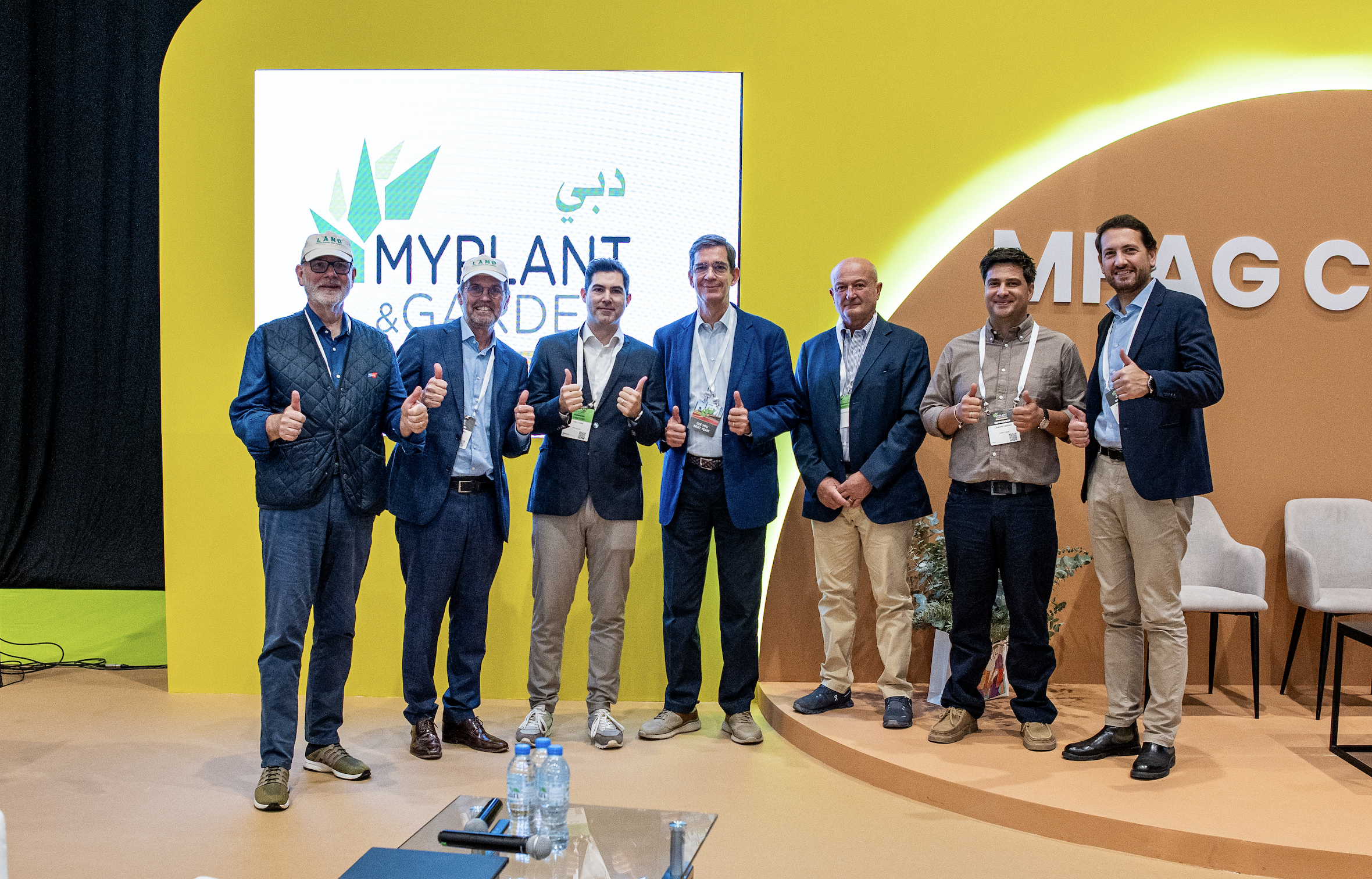
At Myplant & Garden Dubai Middle East Expo alongside Jens Hoffmann, Fabio Lassini (Montana S.p.A.), Giovanni Sala, Nicolò von Wunster, Lawand Barazi, and Stefano Roman
Speaking of new beginnings (and returns), we went back to Dubai, five years after our Expo 2020 experience, ready to plant new seeds of international collaboration.
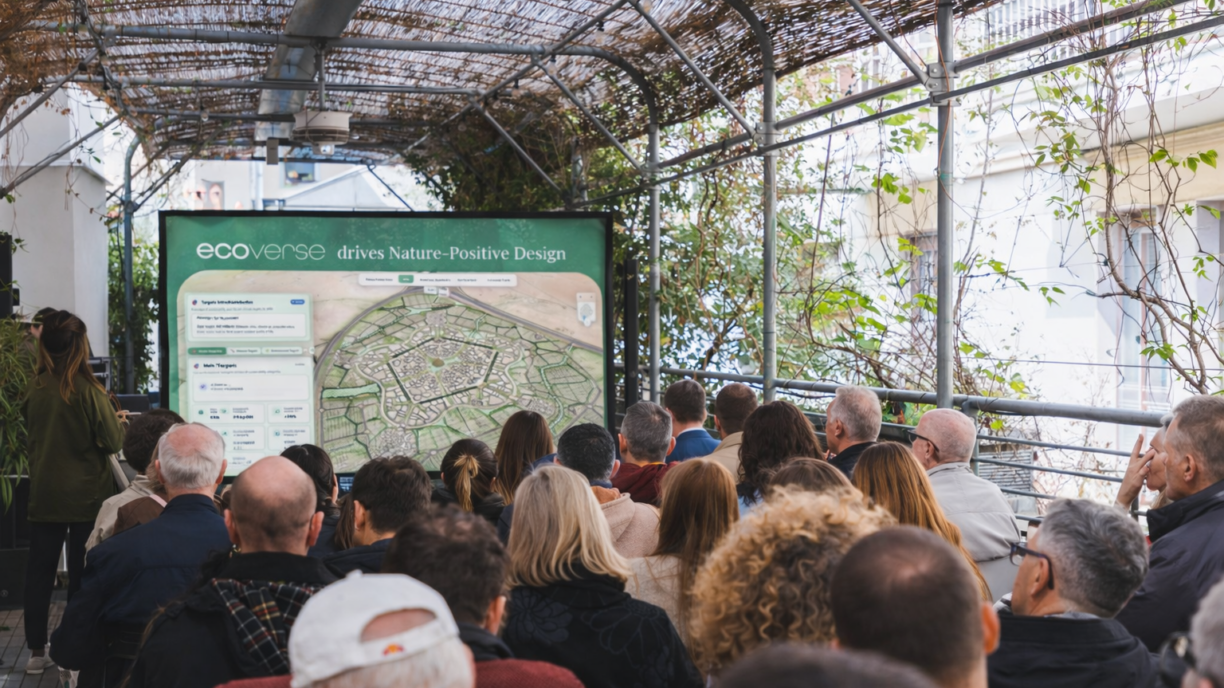
On the occasion of the first edition of Myplant & Garden Middle East Expo, together with Green City Italia we highlighted the vital role of urban greenery in shaping the future of cities across the MENA region, drawing inspiration from our ongoing work in Riyadh.
Alongside our partners at Montana S.p.A., we unveiled the upcoming Competence Center for Territory and Sustainability (CCTES), soon to be established in Saudi Arabia. Promoted by Regione Lombardia, this initiative will foster interdisciplinary collaboration and joint support for research and development, providing strategic guidance for sustainable, large-scale economic growth across the entire Gulf region, especially in view of upcoming global events.
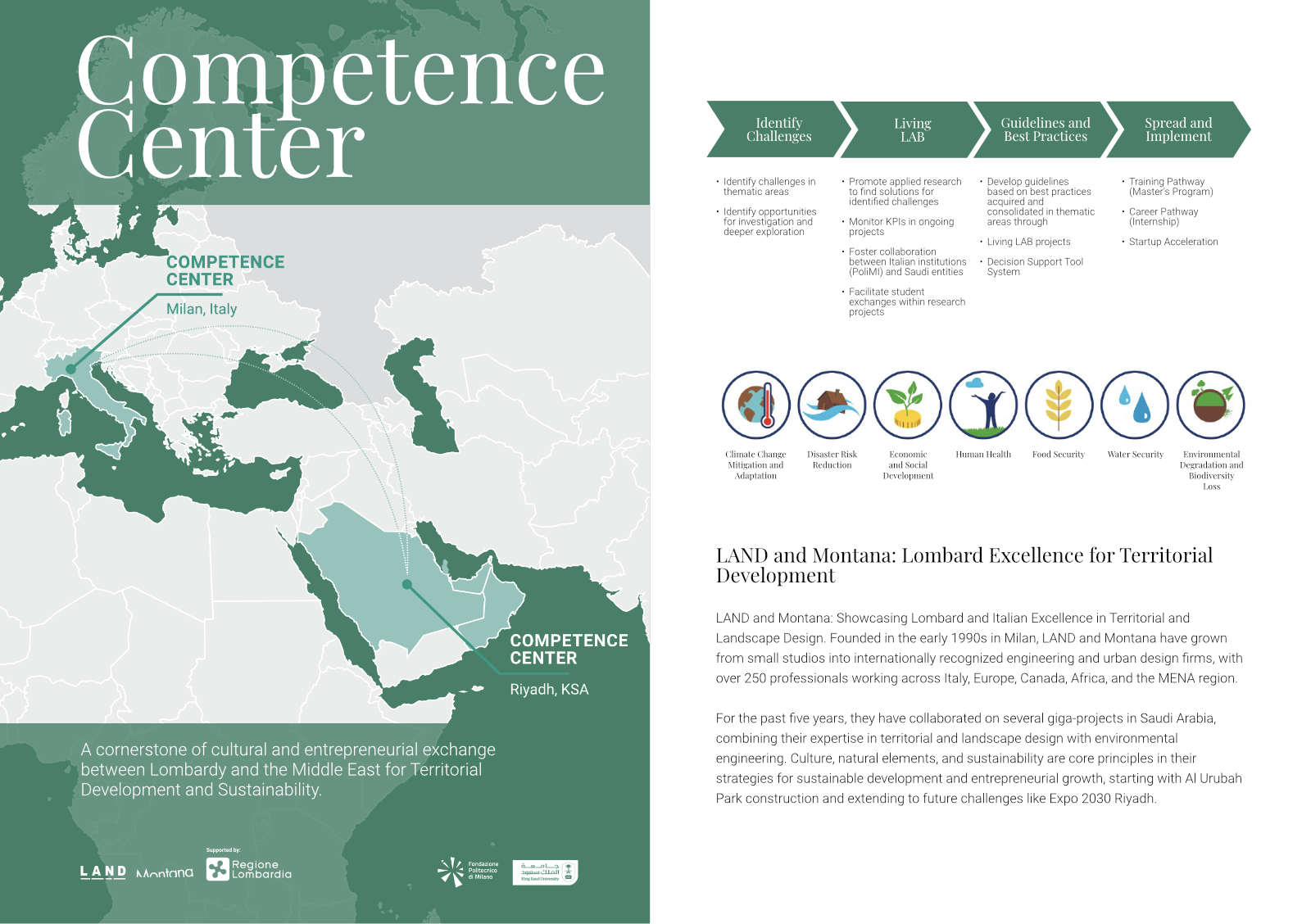
Competence Center for Territory and Sustainability by LAND and Montana promoted by Regione Lombardia
This feeling of cooperation and openness became very tangible during my recent trip to Canada, a country where Nature is not a backdrop, but a driving cultural force. The recent, sudden resignation of Steven Guilbeault, Minister of Canadian Identity and Culture and Minister of Nature and Parks, champion of reducing climate pollution and protecting the environment, urges us to act even more urgently to protect Canada’s ecosystems, its communities, and ultimately, its identity.
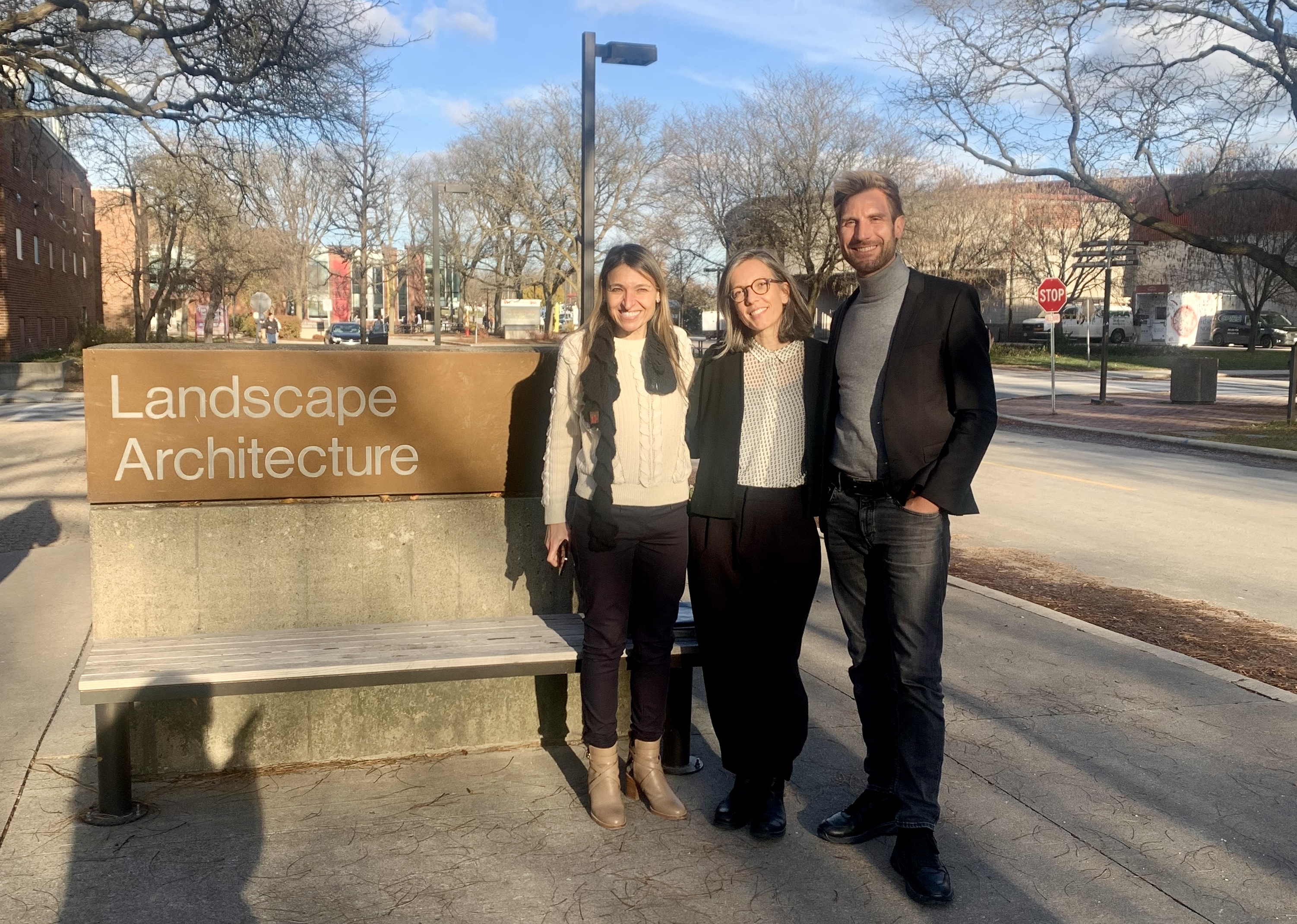
Nadia Amoroso (Associate Professor Landscape Architecture), Valeria Pagliaro and Nikolas Neubert at the University of Guelph
Following the contribution of our CIO Nikolas Neubert at the University of Guelph in Toronto, where he could highlight the increasing value of Natural Capital and our vision of technology at the service of Nature, I travelled to British Columbia and joined Valeria Pagliaro, General Manager of LAND Canada. Valeria’s presence on the ground represents much more than a “branch abroad”: it is a bridge between European experience and North American challenges, between our 35 years of practice and new territories of application.
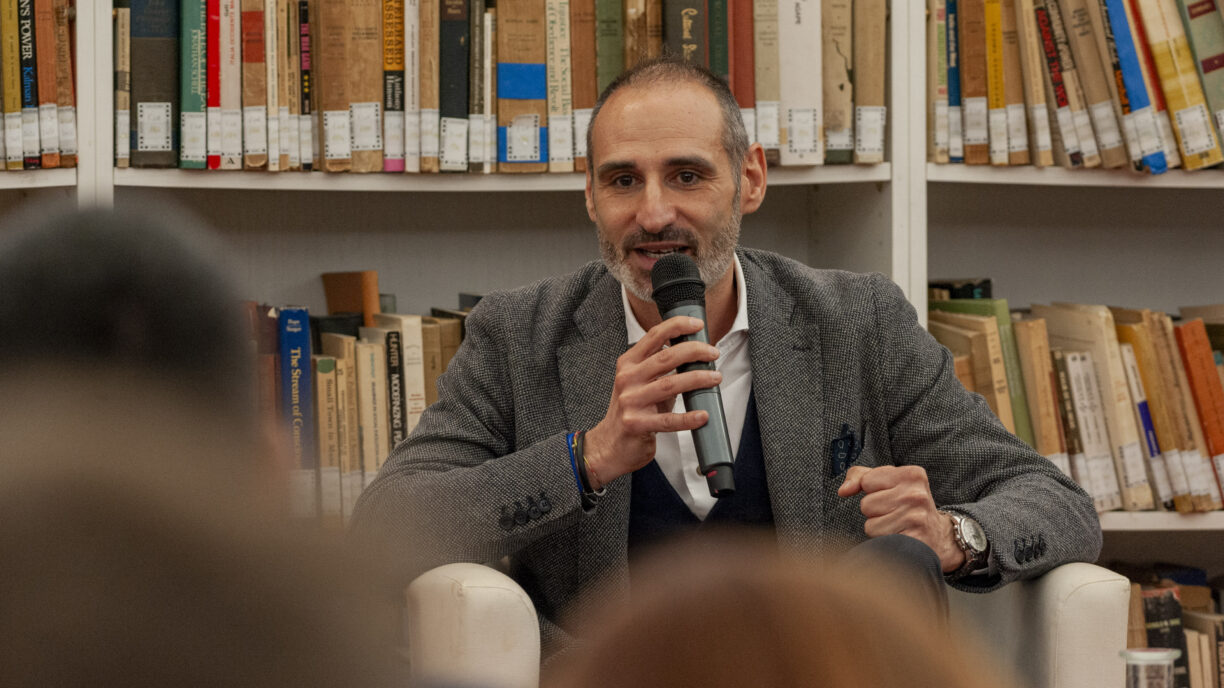
In Vancouver, we gladly joined my colleague and friend Daniel Roehr, Professor of Landscape Architecture at The University of British Columbia. Daniel guided us through the spacious internal areas of the Campus and showed us his work on the multi-sensory landscape we discussed about on the last winter edition of the magazine LANDSCAPES | PAYSAGES. In our joint interview, we explored a broader vision of landscape architecture as living matter, a Nature-Positive Landscape that acts as vital infrastructure for a thriving society.
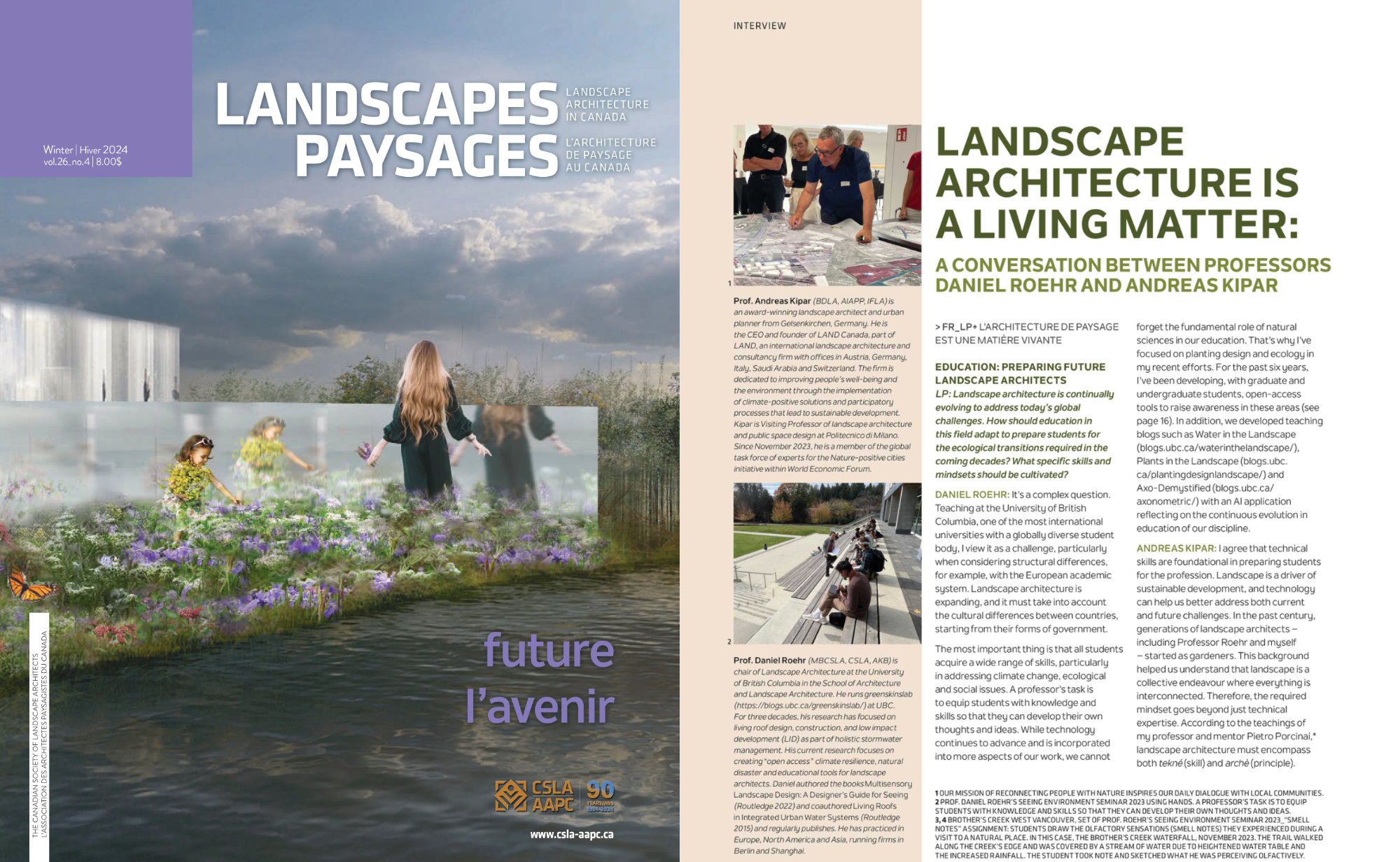
LANDSCAPES | PAYSAGES, winter 2024 edition
From Milan’s Green Rays to the ecological networks of the Ruhr, from the Alpine corridors of Canton Ticino to the strategic landscapes of South Tyrol, during my guest lecture at Robson Square, Vancouver’s civic core and primary public space, I shared evolving examples how bold territorial visions often grow from simple, incremental acts. Step by step, project by project, we learn to reconnect urban systems with natural processes.
Professor Roehr summarised this evolution with a sentence that stayed with me: “As environmental diplomats, our contribution must have a global reach and bypass the borders of our discipline.”
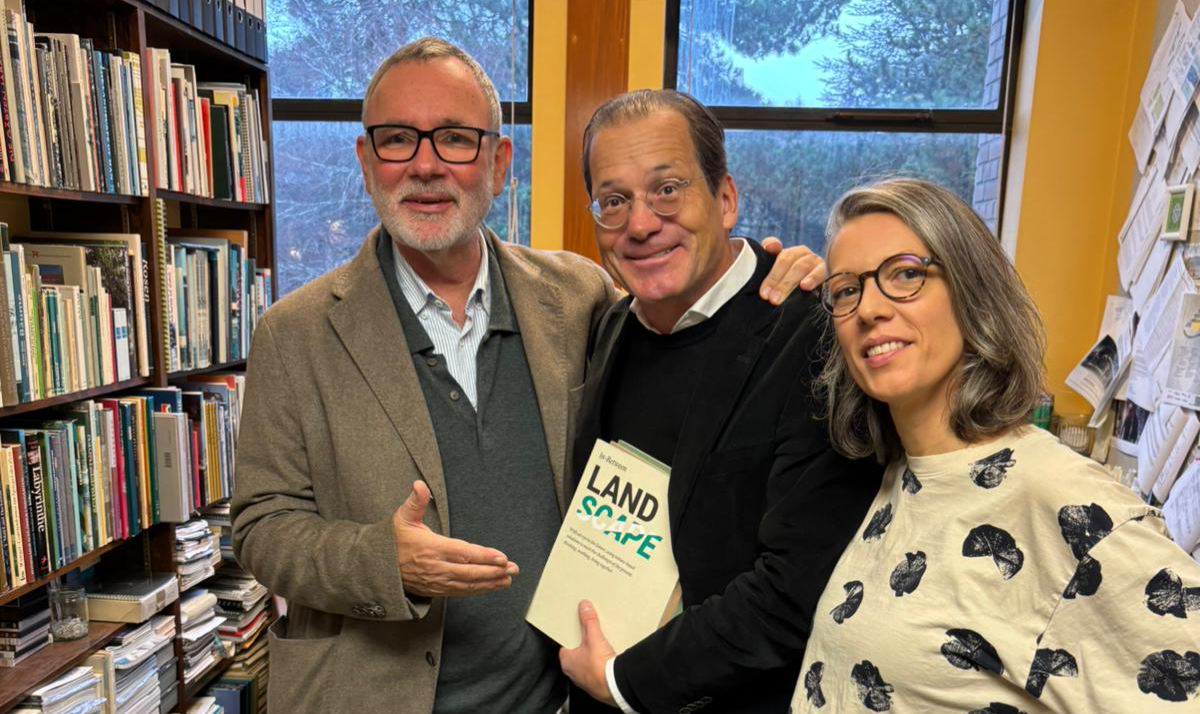
With Daniel Roehr and Valeria Pagliaro at UBC
That is precisely where our profession is heading. A paradigm shift in urban and territorial planning will shape regeneration in Canada – as in the rest of the world – helping us cultivate cities and regions that are more resilient, more connected, and more future-ready.
It’s all about reversing the top-down logic development process infrastructure → settlement → people into a dynamic and open-minded people → settlement → infrastructure. This new approach, putting people at the very core of our work, proceeds through three perspectives: cultural, economic and scientific. That’s what we shared in the spirit of exchange and innovation together with Consul General of Italy Paolo Miraglia del Giudice, who strives every day to support this dialogue between Italy and Canada. Exchanges like these remind me that landscape is also diplomacy: it connects cultures as much as it connects ecologies.
Beyond the Anthropocene: towards a Convivial Conservation of Nature
As I look towards 2026, I draw inspiration from a book that has accompanied my reflections in recent months: “The Conservation Revolution. Radical Ideas for Saving Nature beyond the Anthropocene” by Bram Büscher and Robert Fletcher.
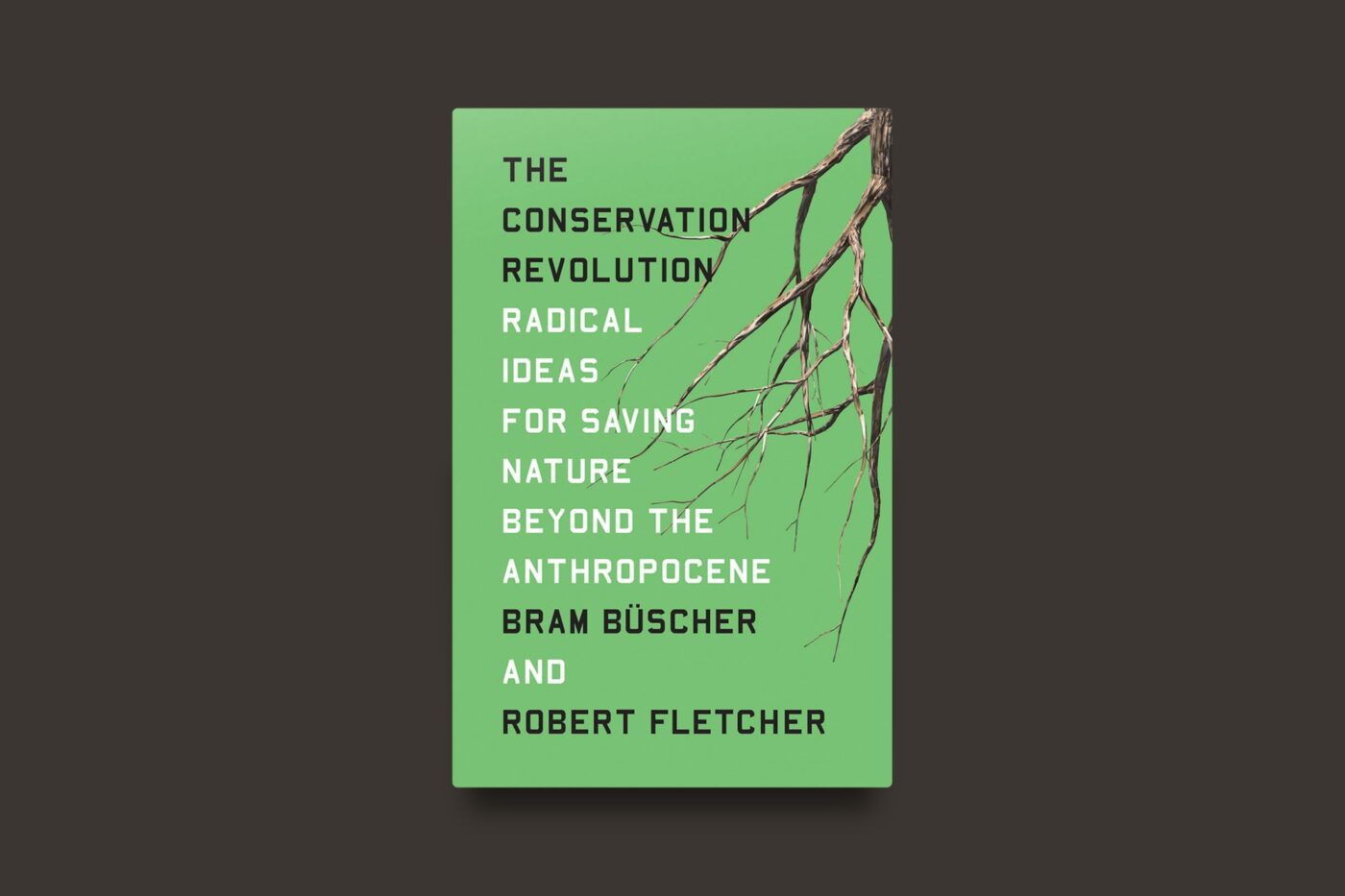
The authors provocatively argue that conservation strategies must move beyond a defensive logic and beyond the idea of Nature as entity separated from us into protected areas. Instead, they propose a “convivial conservation”, a new relationship between human and non-human worlds, based on coexistence, reciprocity, and respect. For me, this idea stands out as one of the most thought-provoking insights as we close the year.
Their proposal resonates deeply with our everyday work.
Landscape, at its best, is precisely this: a convivial space where human and non-human life forms can coexist, negotiate, and evolve together, not as separate spheres, but as parts of one living system. Only so, we’ll move from the “Design with Nature” of Ian L. McHarg to a more encompassing “Design from Nature”.
The old concept of the “project to protect,” already widespread in the 1990s, must give way to a new paradigm.
We are at the beginning of a new journey, and we do not yet know where it will lead. Who will be at our side? It’s a challenge we must face.
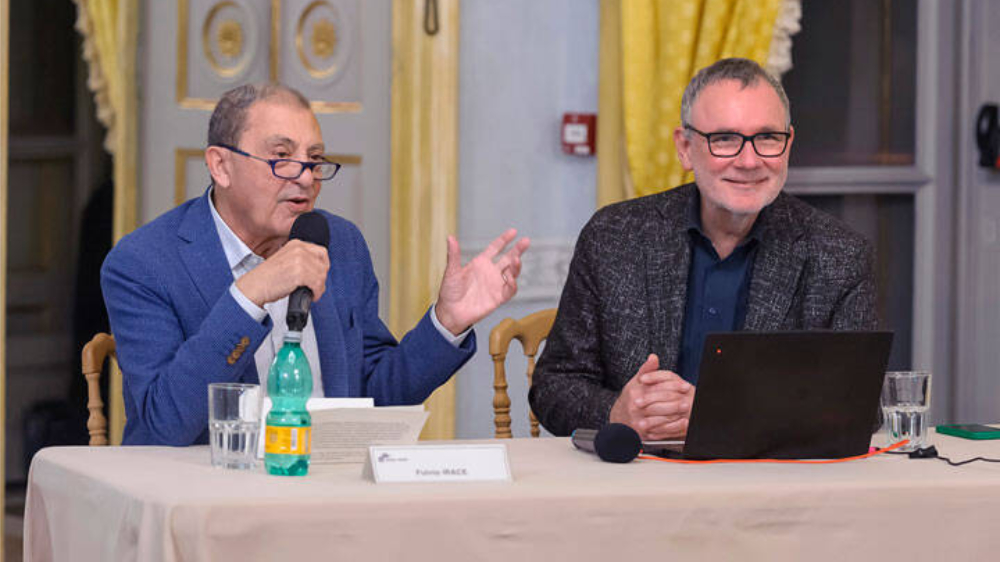
Last week in Berlin, at the #Immpresseclub Conference, I experienced firsthand the real estate sector’s growing openness to redefining its relationship with Nature — increasingly understood as Capital. Discussions with experts from finance, development, and market analysis highlighted both the current pressures on the sector and a shared ambition to unlock new momentum through innovative approaches, where landscape and nature-based solutions are emerging as true drivers for resilient, future-ready cities.
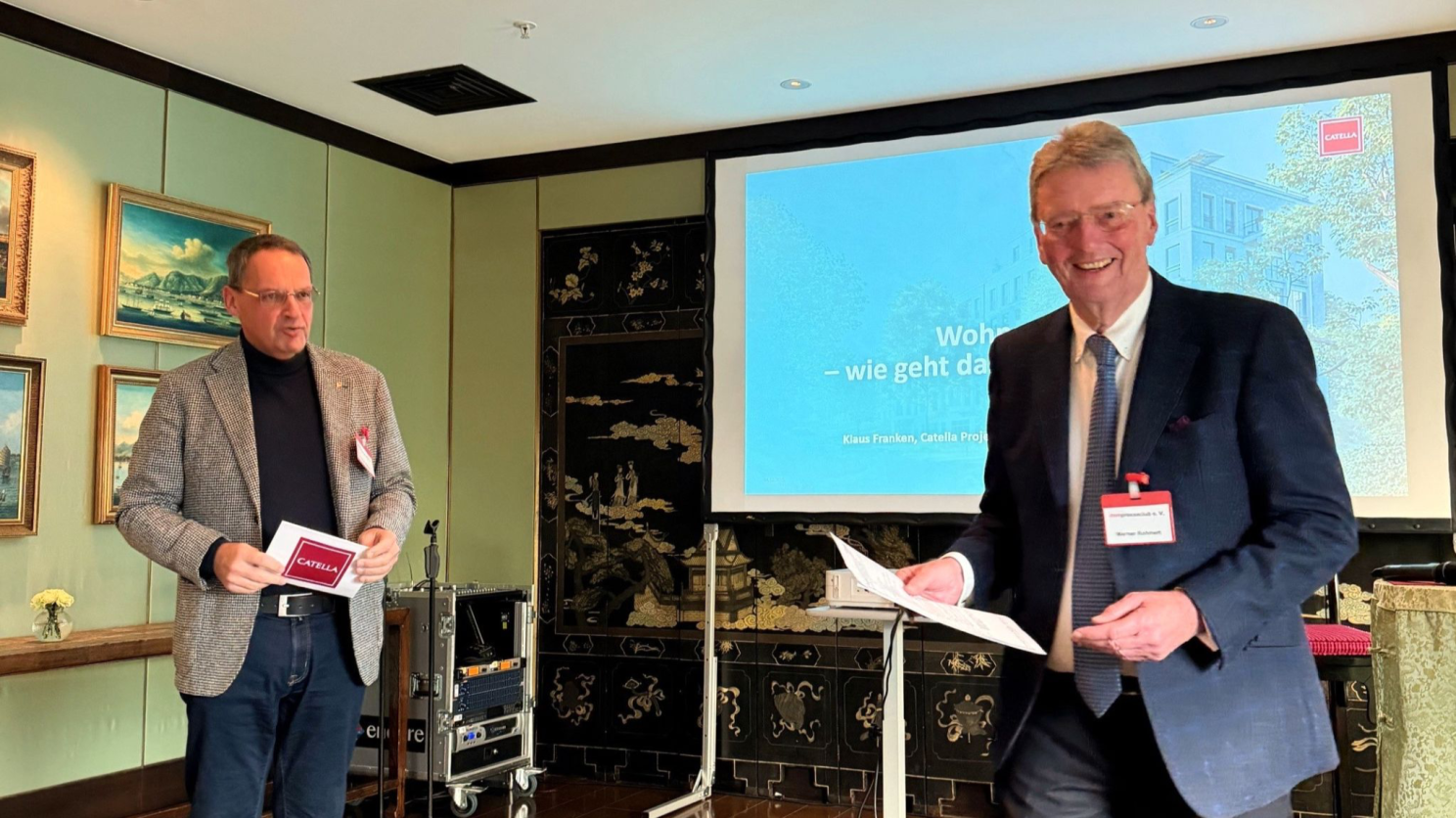
Klaus Franken, CEO at Catella, on “Housing construction – how does it even work today?” at the Impresseclub Conference in Berlin
In 2026, we will continue to build on this foundation: strengthening our ESG strategy as a driver of transparency and innovation, expanding our international collaborations – from Europe to America and beyond, and cultivating landscapes that act as platforms of coexistence between people and Nature.
Thank you for walking with us through 2025, for your trust, your questions, and your shared commitment.
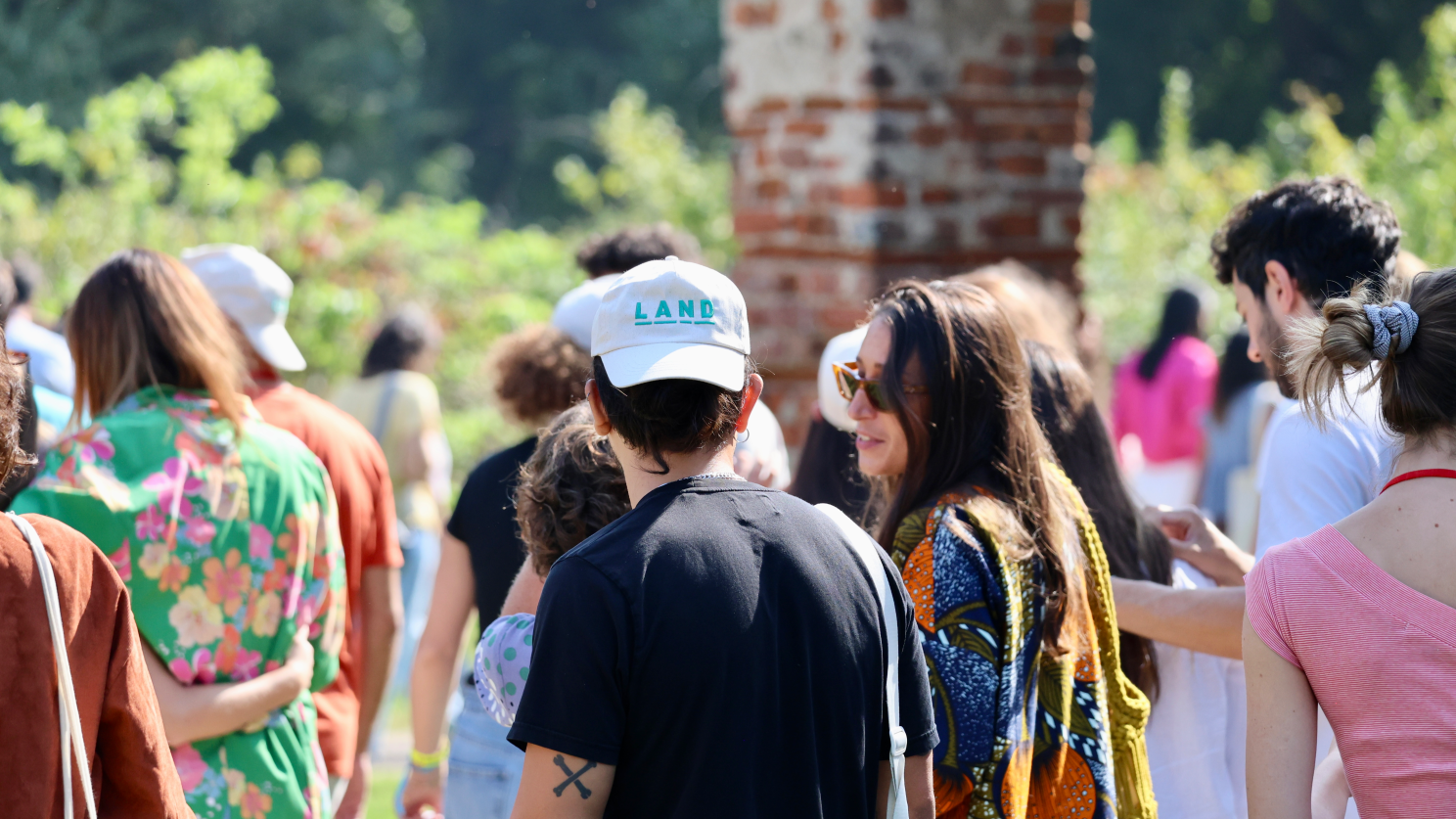
LANDconnects 2025
And my heartfelt gratitude goes to all the colleagues across LAND who, day after day, turn ideas into places, visions into projects, and challenges into opportunities. Our work exists because of their dedication, curiosity, and courage.
Guided by our belief that LANDscape is Life, we will keep cultivating spaces and relationships where environmental performance, social wellbeing, and responsible governance come together.
I wish you a peaceful holiday season and a regenerative pause, looking forward to jumping into 2026 with new ideas, a renewed enthusiasm and a restful mind.