"Green on the ground": Milan 'Healing City' takes root at the Policlinico
A 'healing' Nature that weaves through the pathways between hospital buildings, offering well-being and environmental comfort to patients, staff, and visitors in a place historically dedicated to health. This is the vision of LAND for the regeneration of the open spaces at the Policlinico di Milano, led through permeability and ecological continuity.
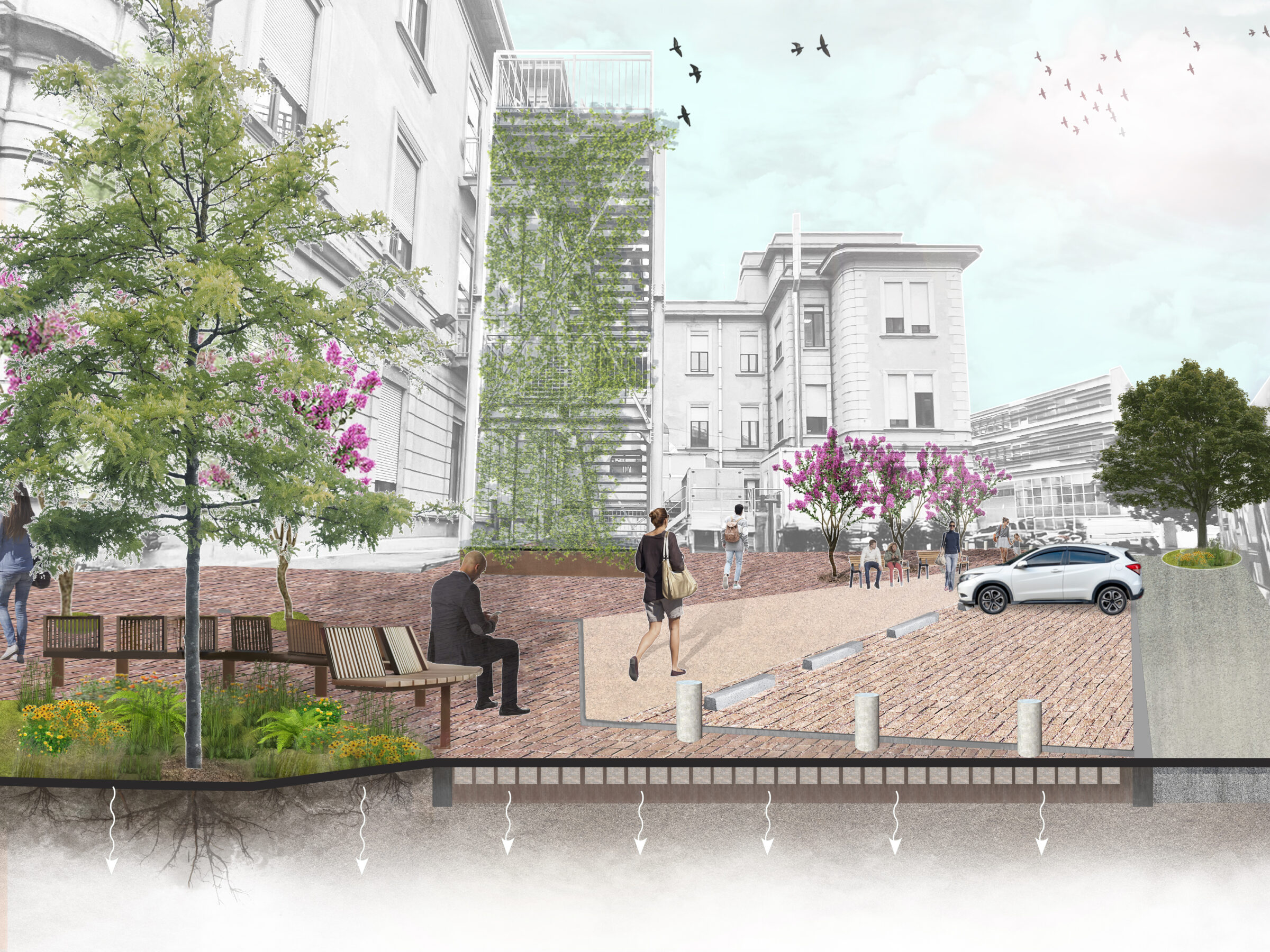
Humanizing with Nature one of Italy’s most important hospital centers. This is the primary goal of the landscape-environmental regeneration masterplan for the open spaces at the Ospedale Policlinico di Milano. Spanning an area of 8.9 hectares, the intervention by LAND Italia includes the removal of 3,122 square meters of impermeable surfaces, which will be replaced by 1,870 square meters of green spaces and 1,970 square meters of green walls, along with the planting of 100 new trees.
The first two specimens of Lagerstroemia indica were planted during the official launch of ‘Green on the Ground’ on Tuesday, March 25, the Day of Pardon, at the Ospedale Policlinico, with the participation of key city and regional authorities. A special day that celebrates 500 years of history while looking toward the future. To mark its 35th anniversary, LAND paid tribute to the Fondazione Ospedale Maggiore Policlinico by gifting the two trees to the city. This marked the beginning of the second phase of the project, focused on the first area of implementation in collaboration with HW Style and Consorzio SIS.
Greenery becomes the catalyst for an integrated and hierarchical system that connects the spaces, facilitates orientation, and offers shade and shelter to passersby, with protected pedestrian paths and smoother crossings. A capillary Nature creates environmental, social, and economic value. Targeted interventions such as de-paving, the use of nature-based solutions, the expansion of pedestrian areas, and the strengthening of safety for soft mobility all contribute to the environmental comfort and well-being of patients, staff, and visitors.
“By planting the first trees of ‘Green on the Ground,’ we have sown a shift in perspective, moving from the built to the unbuilt to reconnect with the soil we walk on,” said Andreas Kipar, CEO of LAND and project lead. “Breaking the asphalt in favor of Green means giving space to Nature, which helps us breathe again, improves the climate quality of our cities, and enhances the buildings themselves, bringing well-being and biodiversity into the daily lives of all. A strong and radical message, materialized as a gift for a Milan that looks to the future as a Healing City: a city that heals its citizens and regenerates itself.”
“This green road toward a new Policlinico represents our way of practicing public healthcare and reflects another side of our legacy: being the largest landowner in Italy, thanks to properties received over the centuries from our benefactors,” added Marco Giachetti, President of the Policlinico di Milano. “All of this aligns with our mission to create a system of care and health promotion that also encompasses a better environment, essential for the maintenance of each individual’s psycho-physical well-being. Therefore, in the project for the New Policlinico, we wanted to emphasize Green, both with the large elevated therapeutic garden and with the creation of a ground-level path that gives ‘breathing space’ to everyone—patients and healthcare workers—who pass through the hospital area every day.”
A result of continuous dialogue with the Fondazione Ospedale Maggiore Policlinico, “Green on the Ground” represents the realization of nature working on multiple levels: from the ground, with the depaving strategy of Let’s Break It Up!, to the elevated element of the Therapeutic Garden for the new Sforza Pavilion, with LAND Italia as part of the project team led by Techint, Boeri Studio Srl, and Barreca & La Varra.
Thanks to Natural Capital Accounting, it will be possible to quantify the ecosystem benefits generated by Green on the Ground during and after its completion. LAND’s environmental performance forecasts indicate that the intervention could reduce the perceived temperature by two degrees, while the new trees could produce approximately 10,000 kg of oxygen annually and simultaneously sequester 15,000 kg of carbon dioxide.
The landscape-environmental regeneration project has been divided into six project areas, ensuring gradual implementation over time.
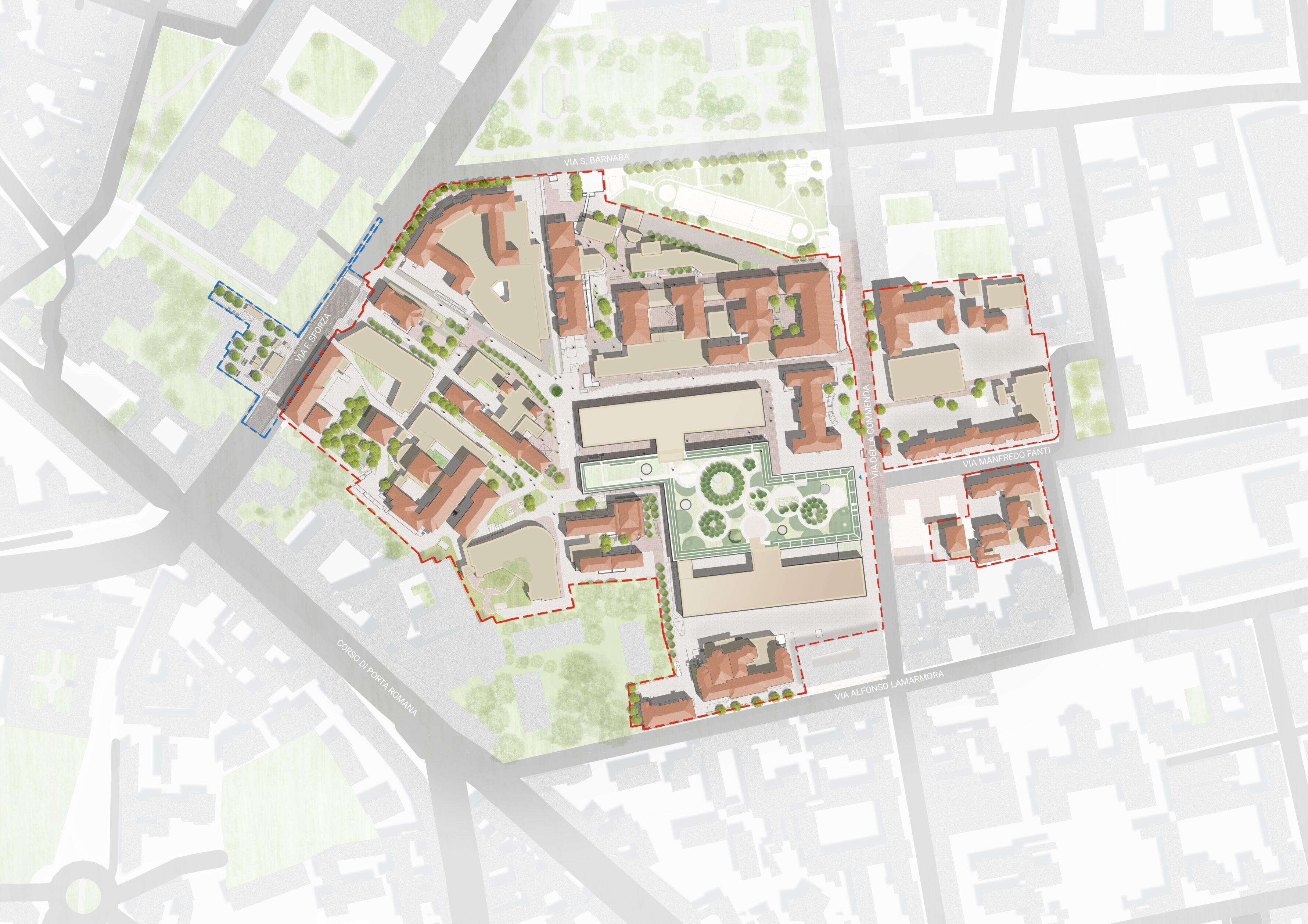
Green on the Ground strategic masterplan