A Transformational String of Pearls
The Power of Ideas and New Life for the Emscher, Lippe and Ruhr
Susanne Gombert, LAND Germany, talks to Uli Paetzel, Chairman of the Emschergenossenschaft and Lippeverband water management associations.

Susanne Gombert, LAND Germany
Susanne Gombert: Karl Ganser, urban planner and far-sighted managing director of the equally revolutionary IBA Emscher Park, said that: “In the long term, landscape in industrial regions in particular can only be preserved from the arbitrary grip of economic interests if the design makes this taboo.“ What does this say about the conversion of a region like the Ruhr, Emscher, Lippe, which is shaped by industrialization?
Uli Paetzel: Karl Ganser‘s goal was to further develop modernity with its industrial structures: through a project with IBA Emscherpark in which he kept these structures and spatial elements, developed them further, and put them to new use. It shows that only someone who has an idea, a clear idea of the future and of the functions assigned to spaces, to structures, can shape the future. And Karl Ganser did that, he sought to prevent the inconsequential use that we see in many places, including the Ruhr region.
Gombert: What basic principle, what ideas are the basis for the structural transformation that has attracted supraregional attention, especially through the “Freiheit Emscher” project?
Paetzel: „Freiheit Emscher“ is one of the greatest areas of development we have in the Ruhr region. It’s designed to show that the socio-ecological transformation of our society can be reflected in this kind of an industrial area. That there must be green and blue connecting paths, there must be a microclimate and a wind concept, a water center could be established. The establishment of an alternative form of supply there must be considered from the very start, using rail, shipping, autonomous driving. And only through this power of ideas will more than the usual industrial region arise.
Our job is to expand all blue-green infrastructure in this region as much as possible, and thus also to achieve greater flood protection and much greater biodiversity.
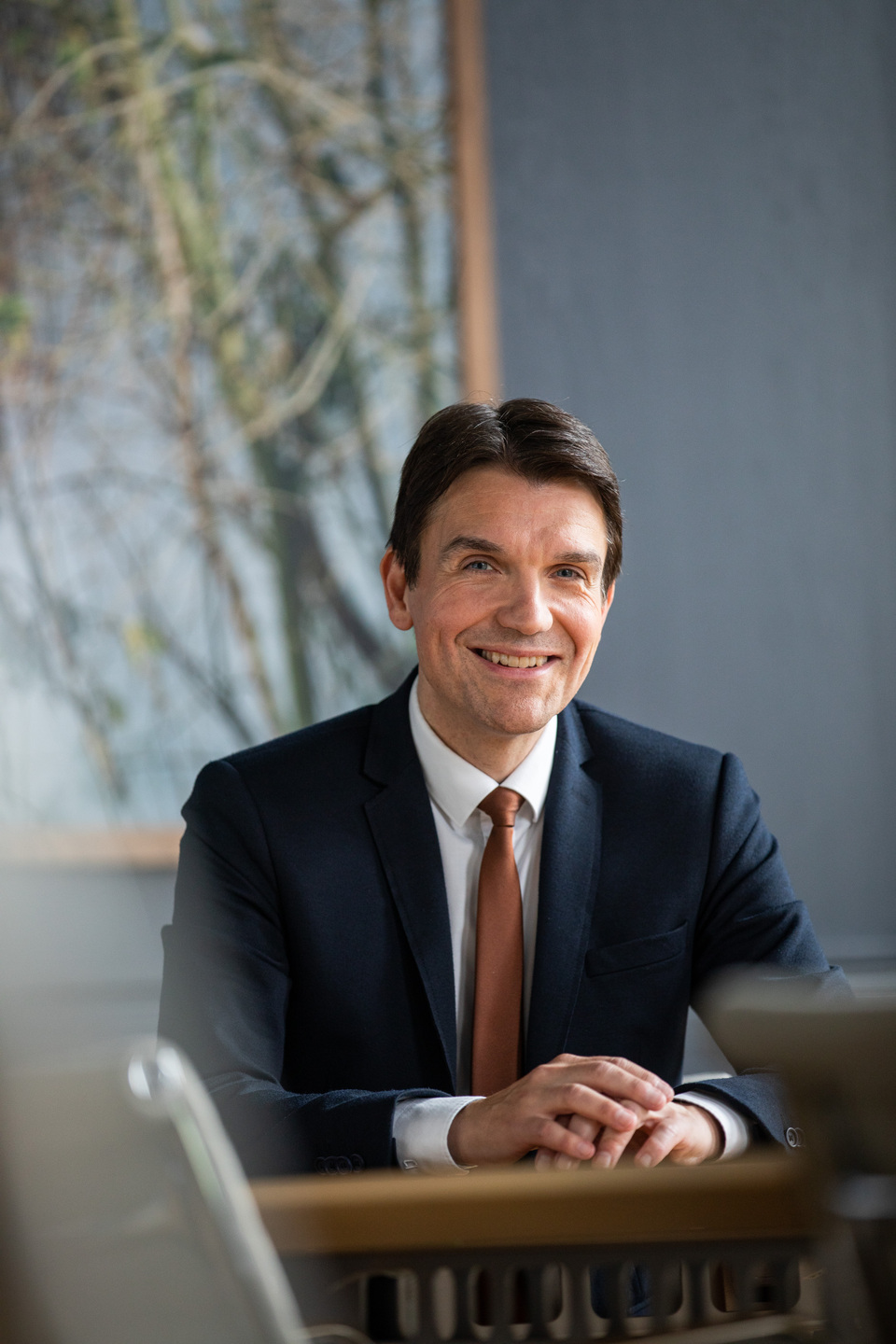
Uli Paetzel, Chairman of the Emschergenossenschaft and Lippeverband water management associations
Gombert: What possibilities does that offer for the development of urban neighborhoods?
Paetzel: I don’t think there’s a neighborhood in the Ruhr region where I’m not within 500 meters of a blue-green infrastructure. The blue-green landscapes that are there or that are being created are very compatible, and that’s regardless of class. We must protect this democratic character at all costs. What we create must be open. It must not be closed, and it must remain compatible for all population groups. After all, we’re living in Germany’s largest city here, with five million people.
Gombert: What role can the Emschergenossenschaft and Lippeverband associations play?
Paetzel: We see ourselves as an infrastructural technical service provider for the region. Since 1899, we’ve performed a number of duties in the field of water management: we manage water, but we also deal with climate adaptation, climate protection. By renaturalizing bodies of water, we are giving ourselves the task of creating Nature anew. Our job is to expand all blue-green infrastructure in this region as much as possible, and thus also to achieve greater flood protection and much greater biodiversity. That’s our goal and aspiration.
Gombert: What does that mean for an understanding of Nature?
Paetzel: Actually, we’re always dealing with Nature, and we need to reflect on what we‘re doing there. In the end, Nature is something that develops by itself and must escape the human grip as much as possible. But we must also be able to experience Nature. We find ourselves in this dichotomy between the possibility of development and the possibility of experience.
Nature is something that develops by itself and must escape the human grip as much as possible. But we must also be able to experience Nature. We find ourselves in this dichotomy between the possibility of development and the possibility of experience.
Gombert: And what does it look like to make this happen?
Paetzel: We‘ve proven that we can do something that no one in the region thought we could do. On schedule and only slightly over budget, we’ve managed to complete a major project that’s more than just a water management project. We‘ve built 436 km of canals, four large sewage treatment plants, countless pumping stations, 200 km of bike paths along 340 km of renaturalized riverways – that’s all solid infrastructure. But the real point is the added value that this creates. Starting with biodiversity through economic stimulus to questions of urban development, neighborhood development, local tourism, health, art and education, issues of participation. A water management project has become a structural change project and an entire region is pulling itself forward based on this idea.
Gombert: What does that mean for the future?
Paetzel: We can’t just stand still. Now we have to continue this transformation. Now we can finally leverage the added value from these areas. We need something like a transformational string of pearls, where shining pearls emerge in a lot of places. And then we‘ll have something along the Emscher that becomes truly influential. Organizing that is our task for the future.
Gombert: A blue-green string of pearls?
Paetzel: This must manifest at all levels of sustainability, at the economic, ecological and social levels. And there’s a fourth level, that of participation. This whole thing only works if we give the landscape back to the people. When we make it clear that this is something we’re doing for you. That’s the democratic context that must always be stressed. Only those who step up, who act, who take things into their own hands, who develop an image and establish democratic compatibility, can hope for success.
Interview from November 2022
Read other Articles from this Edition