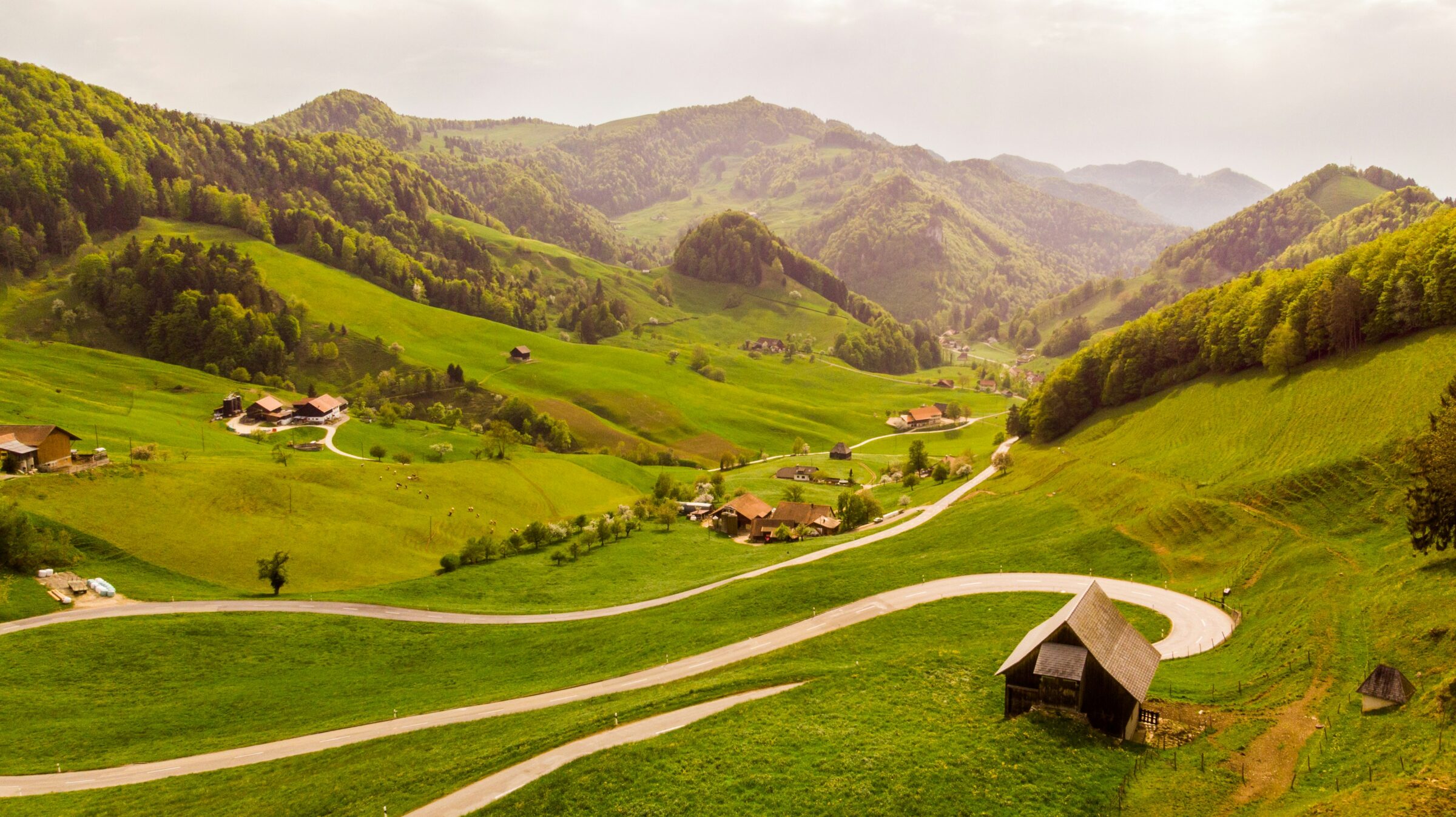
The Land of Green Hearts
Switzerland has a unique opportunity to shape a decentralised, sustainable future in which open spaces, technologies and sustainable development are intertwined. But to turn this vision into reality, politics, planning and society must work together.
A guest article by Joris Van Wezemael, a Swiss-Belgian geographer, urbanist, and entrepreneur who is part of the LAND community.
I imagine a future in which open spaces play a central role in urban and regional planning.
These open spaces should not only exist selectively in urban centres but should be available across the full expanse of the region. A key aspect of my vision is the „a thousand Central Parks“ concept. This model envisages that open spaces will not only exist as isolated green areas but also become a networked system that extends across urban and rural areas.
Open spaces are more than just places of recreation – they act as ‘green hearts‘ around which people’s living spaces unfold.
Joris Van Wezemael, Owner and CEO of de plek GmbH, specializes in strategy consulting, urban transformation, and mediation for complex decisions.
Sustainability: A fundamental challenge
It is not about giving every village a gigantic park, but about transforming the landscape into a functional and aesthetic network of open spaces that enhance life quality. These ‘a thousand Central Parks’ must be designed to be multifunctional: They should serve as local recreation areas, promote biodiversity, support climate protection measures and function as community spaces. Such open spaces offer retreats for nature and, at the same time, meeting places for society – in the middle of settlements and urban centres.
„Dezentralschweiz“ (Decentralised Switzerland*) – a model of action (see below) as well as a book published by Paul Schneeberger and myself – calls for a sustainable reorientation of spatial development. A crucial aspect here is the rediscovery of living and working in the immediate vicinity.
A decentralised way of working, in which people increasingly work from home or in nearby co-working spaces, would drastically reduce mobility and lead to a better work-life balance. Furthermore, it is necessary to reduce land consumption. In recent decades, the increasing demand for living and working space has led to more and more natural areas being sealed off. This development is neither ecologically acceptable nor sustainable.
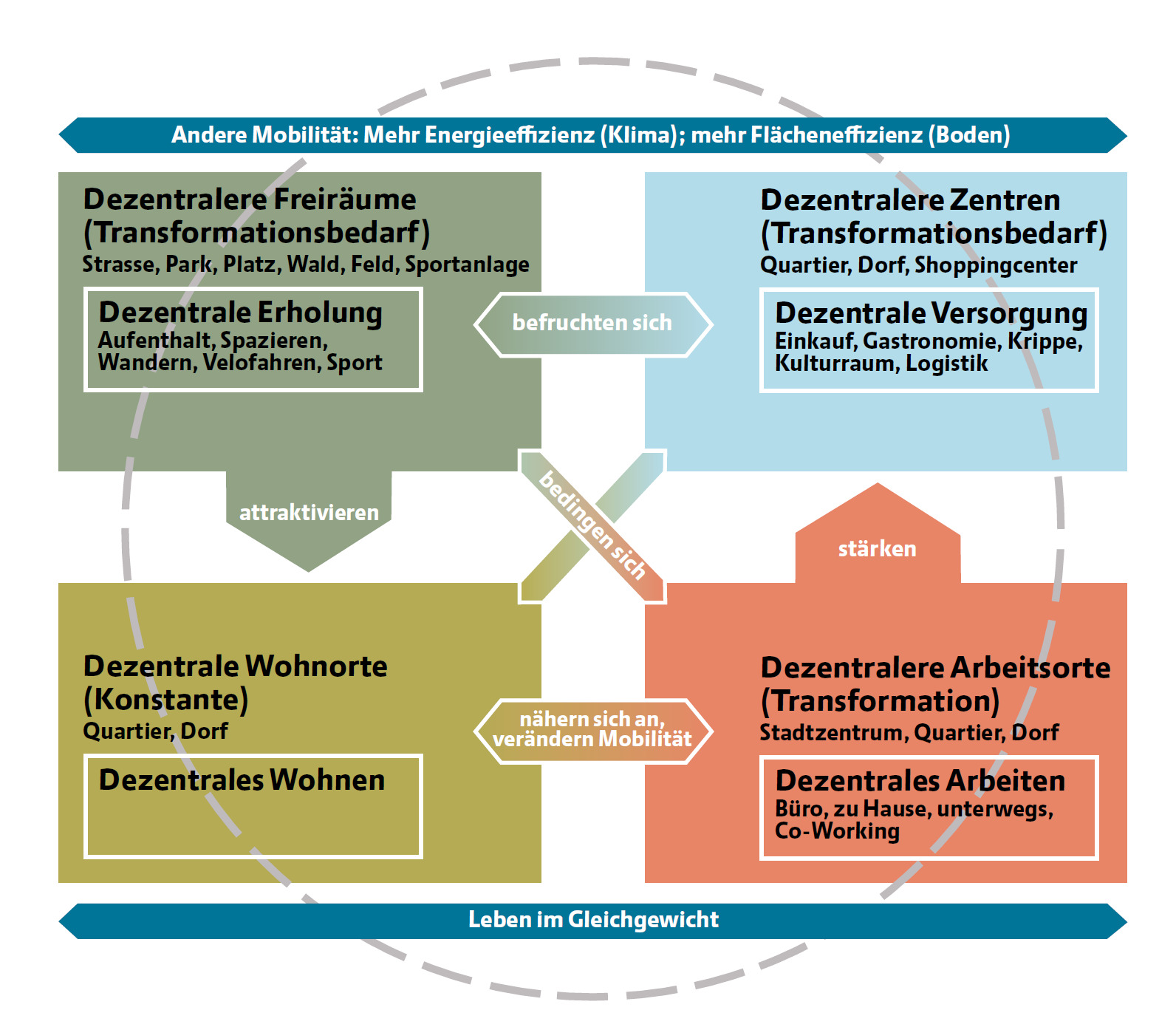
„Dezentralschweiz“ (Decentralised Switzerland*) – a model of action – calls for a sustainable reorientation of spatial development. (c) de plek GmbH
Technology: the lever for change
In addition to open spaces and sustainability, technology also plays a crucial role in my vision of „Dezentralschweiz“. A central element is the intelligent use of data. Technologies like the Internet of Things (IoT) and artificial intelligence (AI) offer us new ways to manage our cities and regions more efficiently. For example, we could use sensor networks in parks or leisure facilities to direct visitor flows and optimise the use of open spaces.
Smart cities are another key concept in „Dezentralschweiz“. In these cities, technologies are used to make residents’ daily lives more efficient while minimising their ecological footprint. This ranges from intelligent traffic control systems that prevent traffic jams and reduce CO₂ emissions to energy systems that make optimal use of renewable energy sources and adjust energy consumption in real-time.
The impact model: who has to do what?
The „Dezentralschweiz“ offers a comprehensive impact model that is based on the principles of flexibility, decentralisation and sustainability. This model shows that it is not just about technological innovation but a fundamental change in how we design and use our living spaces. A central element of the impact model is the close interlinking of settlement development and open space design. When planning living and working spaces, municipalities and cities must pay more attention to creating sufficient open spaces that can be used for various purposes. Furthermore, policymakers must create framework conditions that enable decentralised and sustainable spatial development. This requires close cooperation between the federal government, cantons and municipalities.
The economy also plays an important role in the impact model of „Dezentralschweiz“. Companies must be willing to promote flexible working models and support co-working spaces in rural areas. This would not only reduce mobility but also help to strengthen the economy of rural regions.
Finally, it is also up to the population. Each and every one of us must realise that our living spaces are limited and that we have to use them more consciously. It is not only about living near open spaces but also about protecting them and using them responsibly. Only if we as a society are willing to change our habits can we realise the vision of a decentralised, sustainable Switzerland.